Every researcher who has studied stigmatized behavior, illegal activity, or socially sensitive topics has faced the same fundamental problem: people do not answer honestly when they feel observed.
This is not a character flaw, it is social desirability bias, the well-documented human tendency to give answers that reflect favorably on us, even in anonymous surveys. If you ask someone directly whether they have evaded taxes, used illegal drugs, engaged in academic fraud, or held discriminatory attitudes, a significant proportion of those who have done these things will answer No regardless of how private your survey appears.
The result is systematically underestimated prevalence rates, biased conclusions, and research that does not reflect reality. This is one of the most persistent and underappreciated sources of measurement error in social and behavioral research.
The Randomized Response Technique (RRT) was developed specifically to address this problem. First introduced by S.L. Warner in 1965 and later refined by Greenberg and colleagues in 1969, RRT is a survey method that provides respondents with a mechanism for truthful disclosure while making it statistically impossible for the researcher or anyone else to know what any individual actually answered.
| Core Principle The Randomized Response Technique introduces controlled randomness into the survey process. Respondents use a randomizing device (coin flip, die roll) whose outcome is visible only to them. The researcher cannot determine how any individual responded but can still estimate the true prevalence of the sensitive behavior across the population using probability mathematics. Individual privacy is protected. Population-level truth is recoverable. |
How the Randomized Response Technique Works?
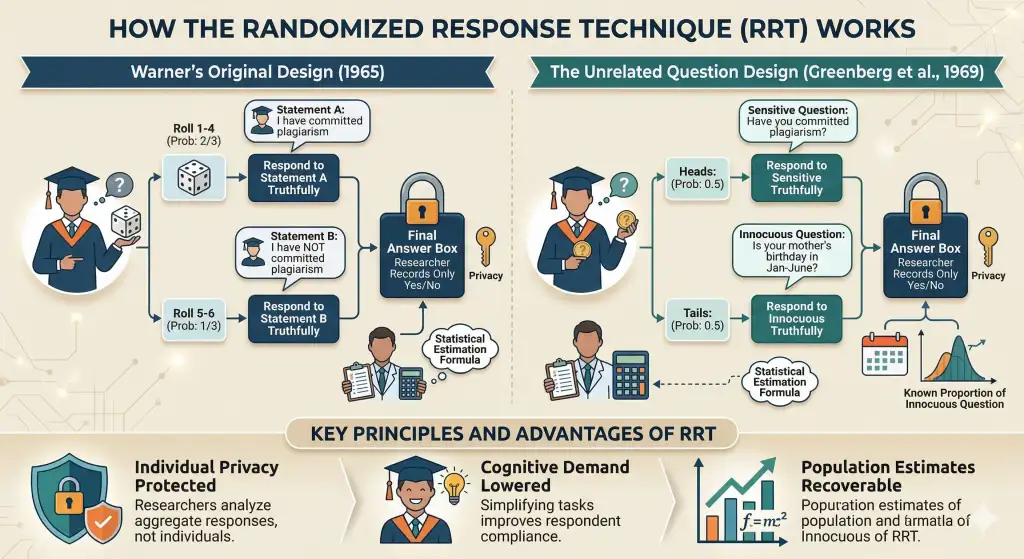
The mechanics of RRT are best understood through an example. Suppose a researcher wants to estimate the true prevalence of academic plagiarism among graduate students — a topic where direct questioning would almost certainly produce severe underreporting.
Warner’s Original Design (1965)
In Warner’s original design, respondents are presented with two statements — for example:
- Statement A: I have committed plagiarism in the last 12 months.
- Statement B: I have NOT committed plagiarism in the last 12 months.
Before answering, the respondent privately rolls a die. Rolling 1–4 (probability 2/3) means they answer Statement A truthfully. Rolling 5–6 (probability 1/3) means they answer Statement B truthfully. The researcher records only Yes or No — and cannot know which statement was being answered.
Using the known probability of the randomizing device, the researcher applies a straightforward statistical formula to calculate the estimated true proportion of the sensitive characteristic in the population. Individual privacy is protected. The population estimate is mathematically recoverable.
The Unrelated Question Design (Greenberg et al., 1969)
A more widely used and easier-to-explain variant replaces Statement B with an entirely unrelated, innocuous question, for example: Is your mother’s birthday in the first half of the year (January to June)?
The respondent flips a coin. Heads: answer the sensitive question truthfully. Tails: answer the innocuous question truthfully. Because the researcher knows the approximate population proportion for the innocuous question (roughly 50% for birthday month), they can back-calculate the true proportion for the sensitive question. This design is preferred in practice because it is less cognitively demanding and easier to explain to respondents, which improves compliance.
The Four Main RRT Designs: A Comparison
| Design | How It Works | Best For | Key Limitation |
| Warner’s Original (1965) | Respondent randomly answers either sensitive Q or its inverse | Dichotomous sensitive variables; foundational RRT research | Probability cannot be 50/50; math requires p ≠ 0.5 |
| Unrelated Question Design | Respondent randomly answers either the sensitive Q or an unrelated innocuous Q | Multi-topic surveys; most practical variant | Requires knowing the true proportion of innocuous Q in population |
| Forced Response Design | Some respondents instructed to always say Yes or No regardless of truth | Online surveys; computer-assisted interviewing | Participants may distrust random instruction; compliance issues |
| Crosswise Model | Two questions posed simultaneously; respondent indicates if answers are same or different | High-sensitivity topics; avoids direct Yes/No on sensitive item | More cognitively demanding; requires careful instruction |
When Should You Use the Randomized Response Technique?
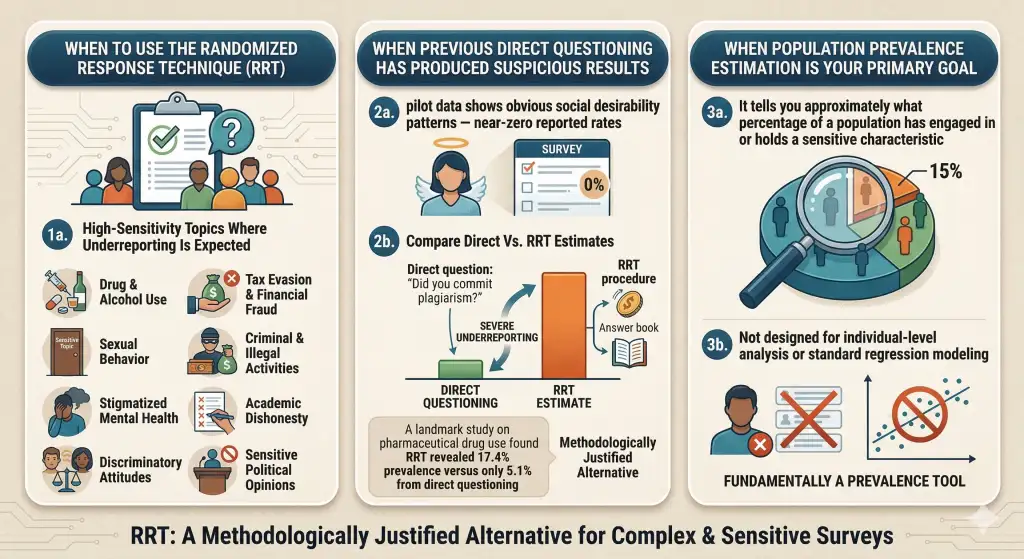
RRT is not the right tool for every survey. It introduces complexity in administration and analysis, and requires larger sample sizes than direct questioning to achieve equivalent statistical power. However, it is particularly valuable for:
High-Sensitivity Topics Where Underreporting Is Expected
- Drug use, alcohol abuse, and substance addiction
- Tax evasion, financial fraud, or corruption
- Sexual behavior, including infidelity or non-normative practices
- Criminal or illegal activities
- Stigmatized mental health conditions
- Academic dishonesty such as plagiarism, data fabrication, cheating
- Discriminatory or prejudiced attitudes
- Political opinions in polarized or authoritarian environments
When Previous Direct Questioning Has Produced Suspicious Results
If previous studies using direct questioning on your topic have produced suspiciously low prevalence estimates, or your pilot data shows obvious social desirability patterns near-zero reported rates for a behavior you have reason to believe is common. RRT is a methodologically justified alternative. A landmark study on pharmaceutical drug use found RRT revealed 17.4% prevalence versus only 5.1% from direct questioning in the same population.
When Population Prevalence Estimation Is Your Primary Goal
RRT is fundamentally a prevalence estimation tool. It tells you approximately what percentage of a population has engaged in or holds a sensitive characteristic. It is not designed for individual-level analysis or standard regression modeling without significant statistical adaptation.
Limitations and Criticisms of RRT
RRT is powerful, but it has documented limitations that your methods section must acknowledge — and that peer reviewers will check.
Non-Compliance With Instructions
A significant proportion of respondents in RRT studies do not follow randomization instructions correctly, particularly in online settings without an interviewer to explain the procedure. Research on conservation behavior found non-compliance was common but rarely accounted for in study design or analysis, which can undermine the anonymity benefit and introduce systematic bias.
False No Bias
Empirical validation studies have found that RRT designs still show a false no bias — respondents with the sensitive characteristic sometimes answer No even when the randomization should have protected them. This is most pronounced for highly incriminating behaviors. RRT estimates may still underestimate prevalence, just less severely than direct questioning.
Reduced Statistical Power
Introducing random noise reduces the statistical efficiency of the design. RRT studies typically require 2 to 5 times the sample size of a direct-question survey to achieve equivalent statistical power. Conduct a formal power analysis before data collection. The R package rr (Blair, Imai, and Zhou) provides purpose-built power analysis tools for RRT studies.
Trust and Comprehension
If respondents do not trust or understand the randomization procedure, they will not use it honestly. Effectiveness depends on participant buy-in. Clear instructions and a visible, simple randomization mechanism improve compliance significantly.
Practical Implementation: How to Include RRT in Your Research Design?
- Step 1 — Choose the right design: For most social science and public health surveys, the Unrelated Question Design is the most practical. If your topic involves attitudes rather than behaviors, the Crosswise Model may provide better estimates.
- Step 2 — Determine your sample size: Use a formal power analysis based on your expected prevalence and the efficiency of your chosen RRT design. Statistical packages including R package rr provide purpose-built tools.
- Step 3 — Write clear instructions: In online surveys, use animated demonstrations or step-by-step visual guides. In face-to-face surveys, demonstrate the randomization procedure before the sensitive section begins.
- Step 4 — Report your methods transparently: In your manuscript, describe the specific RRT design used, the randomization device and its probabilities, the innocuous question if applicable, and the statistical formula used to estimate population prevalence. Reviewers at Scopus-indexed journals expect this level of methodological detail.
| Key Takeaway for GRS Members If your research topic involves behavior or attitudes with high social desirability bias, direct questioning will produce systematically biased data. The Randomized Response Technique, despite its limitations, remains one of the most robust and widely validated methods for obtaining honest responses to sensitive survey questions at the population level. Use it when the topic warrants it — and report it transparently when you do. |
Conclusion
The Randomized Response Technique is not a silver bullet for sensitive survey research, but it is among the most rigorously validated tools for reducing social desirability bias and improving data quality on stigmatized topics. Understanding its mechanics, selecting the right design variant, accounting for sample size requirements, and reporting methods transparently are all essential to producing credible, publishable research.
As a member of the Global Research Society, you have access to a community of researchers, methodologists, and peer reviewers who can help you refine your survey design before you collect a single data point. Methodology consultation is one of the most underutilized benefits of academic community membership.
| Join a Global Community of Researchers The Global Research Society connects researchers, institutions, and contributors worldwide through open collaboration, peer exchange, and shared methodology resources. Explore Membership: grsoc.com/memberships |